|
1
|
- An Introduction
- Andreas Mehler/Sunny George
|
|
2
|
- “... is the attempt to exert influence on the way a conflict is acted
out, so as to regulate it, prevent violence and put an end to any
existing violence. Conflict management aims to achieve constructive
solutions which benefit all participants”
(Definition proposed by GTZ)
|
|
3
|
- Conflicts exist – difficult to be prevented, but possible to be
transformed
- Conflict management builds on earlier activities of crisis prevention
- The reduction of the potential of violent conflict is important.
- The establishment of institutions to resolve conflict peacefully is a
necessity
|
|
4
|
- Peace-Building concerns the whole process of establishing or
re-establishing the network of social relations
- e.g. the creation of job opportunities after a war has ended that might
have destroyed a production site
- Peace-keeping usually starts with the military separation of hostile
parties by blue-helmet troops and can extend to other activities
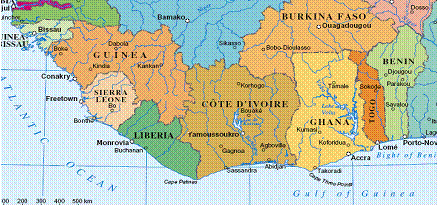
- e.g. the UNMIL mission in Liberia
is a peace-keeping mission with civilian task. However, it has no
ability to “build peace” and its stay will be limited in time.
|
|
5
|
- A neutral party directs the process of conflict management and assists
all parties involved in the declaration of their interests and the
development of inclusive solutions.
|
|
6
|
- “ownership of conflict”
- Early engagement
- Strengthen „peace constituencies“ (often: women)
- Take „spoilers“ into account
- Long-term involvement
- impartiality
|
|
7
|
- Early warning
- In-depth studies
- Mapping of actors
- Peace and Conflict Impact Assessment
|
|
8
|
- People can turn to Parliament and do not seek self help
- Parliament is a mediation body
- Free and peaceful debate
- Suggestion of solutions
- Legislative powers
- Checks on government action
- Missions of inquiry to investigate local outbursts of violence
|
|
9
|
- Influential opinion leader on the local level
- Not taking sides when approached by conflict parties
- Mediation of local conflicts by herself / himself
- Earlier knowledge and better understanding of local conflicts – resource
person at the national level
- Drawing attention to serious grievances in his or her home county
|
|
10
|
|
|
11
|
|
|
12
|
|
|
13
|
|
|
14
|
|
|
15
|
|
|
16
|
- Limits of national initiatives. Conflicts can spill over borders
- Militias can be recruited to fight in the neigbouring arena
- Demobilisation has a very strong regional dimension !
- Small arms may transit uncontrolled frontiers
- Disarmament has a very strong regional dimension !
- Poorly administered hinterlands in the hands of non-state actors
disregarding frontiers
- Identity groups on both sides of the border: loyalty with whom?
|
|
17
|
- Parliament can interact with Parliaments of the sub-region to contain
conflicts
- Banning of a destructive discourse, xenophobia
- Having joint inquiry missions of two Parliaments in border areas
- Individual MPs in border regions can act as early warning agents, as
mediators in cross-border conflicts.
- They can be used as brokers by the neighbouring country‘s authorities in
a local conflict
|

 Notizen